When a batch of oxygen concentrators arrives on the workbench, the symptoms are often identical: "System Error," "Low Purity," or intermittent shutdowns. For the repair technician, the challenge isn't just identifying that the machine is broken, but distinguishing between a mechanical wear-out and a catastrophic logic failure.
While pneumatic components like compressor cups and sieve beds have a predictable lifecycle, the electronic control module—the "brain" of the PSA (Pressure Swing Adsorption) cycle—requires a different diagnostic approach. If the control logic drifts, the machine becomes a paperweight, regardless of how fresh the molecular sieve is.
This guide outlines the protocol for troubleshooting oxygen concentrator PCB faults, moving from signal analysis to the integration of universal replacement solutions.
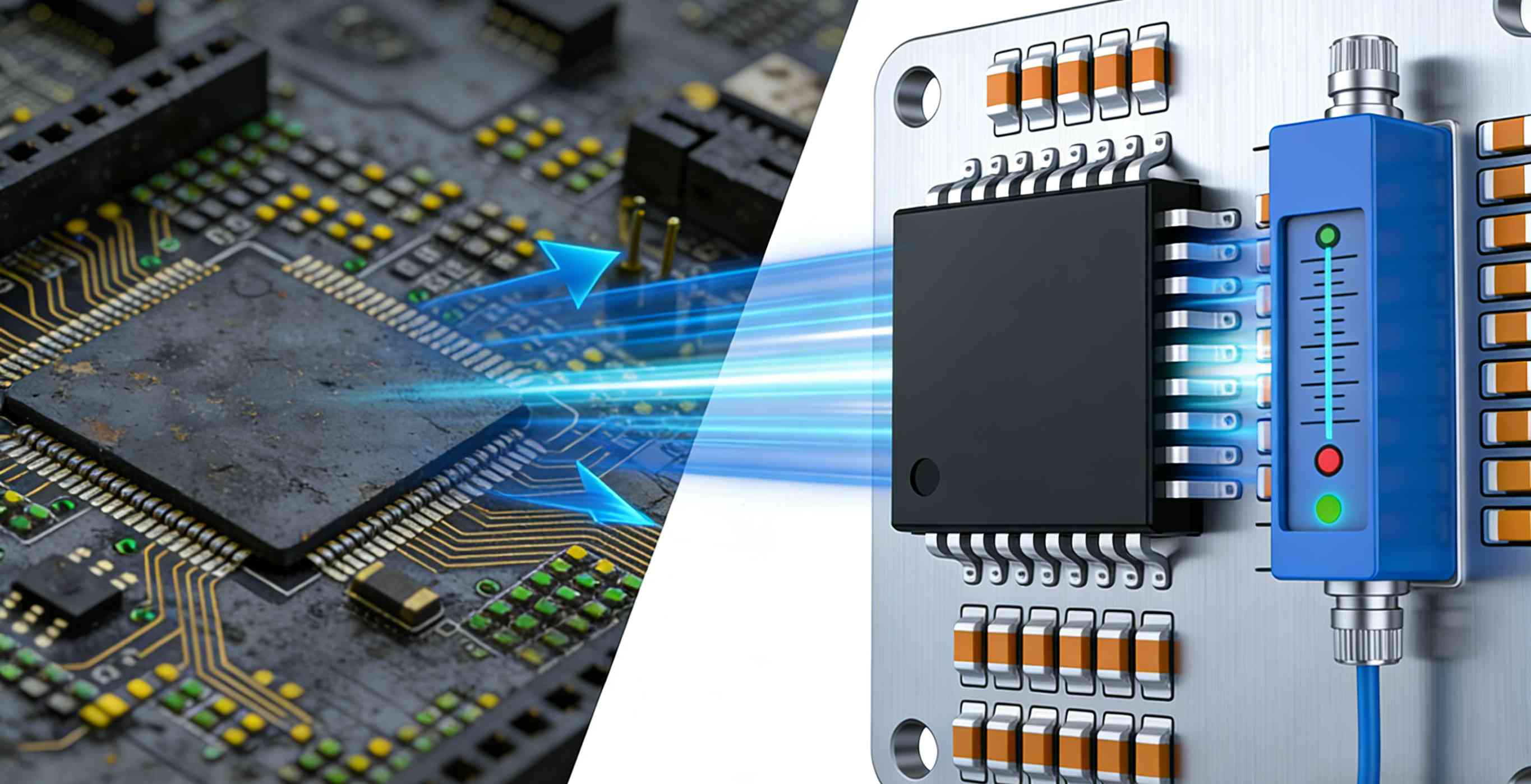
Differential Diagnosis (Pneumatics vs. Logic)
Before probing the circuit board, we must isolate the pneumatic load. The control board relies on sensor feedback to regulate valve timing. If the physical airflow is compromised, the data fed to the Microcontroller Unit (MCU) will be skewed, leading to "Ghost Errors"—logic faults that are actually mechanical restrictions.
- Inlet Depression: Measure the vacuum at the compressor intake. A clogged HEPA filter forces the motor to draw excess current. If the current spike triggers a board shutdown, the fault is mechanical, not electronic.
- Sieve Bed Saturation: If oxygen purity remains < 87% across all flow settings, the beds are contaminated. However, if purity fluctuates rapidly (e.g.90% - 82%- 88%) within seconds, the issue is likely valve timing drift caused by a failing logic controller.
- Solenoid Actuation: Use a multimeter to check the voltage pulse at the valve connectors. A healthy board delivers a sharp, defined square wave. A decaying signal indicates capacitor failure in the board’s driver circuit.
If the pneumatics pass the physical inspection, the instability is rooted in the electronics.
Power Architecture and Voltage Protection
In a refurbishment environment, you often see machines damaged by "dirty" power. A robust control board acts as the first line of defense. When evaluating whether a board needs replacement, check its protection history and current handling capabilities.
Industrial-grade boards, such as those meeting IPC-A-610 Class 2 manufacturing standards, utilize specific threshold logic to protect the expensive compressor and sieve beds.
Table 1: Critical Voltage Protection Logic
| Diagnostic Parameter |
Trip Threshold |
System Response |
| Over-Voltage Cutoff |
> 265V AC |
Immediate shutdown to save the MCU and varistors. |
| Under-Voltage Shutdown |
< 185V AC |
Prevents "Motor Stall" (humming without rotation), protecting coils from thermal ruin. |
| Surge Protection |
4KV |
Lightning/Surge protection (Standard IEC 61000-4-5). |
| Standby Consumption |
< 5W |
Indicates efficient inverter control (Eco-Mode). |
Data Source: Universal Medical Grade Control Board Specifications.
If you encounter a unit that powers on but repeatedly triggers a "System Fault" despite stable wall voltage, the onboard voltage sensing network has likely degraded.
The PID Loop and Processing Speed
The difference between a consumer-grade appliance and a medical-grade device often comes down to the processor speed.
Old or generic boards often use simple 8-bit timers. Modern systems require Proportional-Integral-Derivative (PID) flow sensors. The PID loop constantly compares the actual flow rate against the target flow rate and adjusts the motor speed or valve timing to compensate.
The "Hunting" Symptom:
If you hear the compressor speeding up and slowing down in a rhythmic "hunting" pattern, the board's processor is lagging. It cannot calculate the flow correction fast enough.
The Hardware Solution:
This is where upgrading becomes necessary. High-performance universal boards now utilize ARM Cortex-M4 processors clocking at 120MHz.
Response Time: < 2 seconds.
Stability: about 0.1 LPM.
By processing sensor data faster, these boards eliminate the "lag" that causes fluctuating purity, restoring the machine to a condition often better than factory standard.
Thermal Management and Safety Redundancy
Heat is the primary cause of component aging in power electronics. A standard diagnostic check should include a review of the thermal sensors.
A comprehensive control system should monitor three distinct zones:
- Compressor Coil Temp: To prevent insulation breakdown.
- Exhaust Temp: To verify cooling fan efficiency.
- PCB Ambient: To protect the MCU from thermal runaway.
Double Over-Current Detection
For technicians, the most valuable feature in a replacement board is Double Over-Current Detection. Unlike a simple fuse that blows after damage occurs, intelligent boards detect the specific waveform of a motor stall versus a short circuit. They cut power electronically in milliseconds. This feature is essential for protecting the wiring harness in older chassis where insulation may be brittle.
The Retrofit Protocol
When a board is confirmed dead—due to burnt tracks, sensor drift, or processor failure—sourcing an exact OEM replica for an out-of-warranty machine is often impossible or cost-prohibitive.
This is where understanding Universal Oxygen Concentrator Control Board compatibility becomes a strategic advantage for repair centers. Instead of scrapping the machine, you can retrofit it with a universal module, provided it matches the "Technical Architecture."
Compatibility Checklist for Retrofitting:
- Power Output: Ensure the board is rated for the compressor (e.g. 350W Rated Power).
- Interface: Does the board support the existing display (UART, SPI, I2C)?
- Sensor I/O: Verify the board accepts the standard 5-Pin Waterproof sensor input.
Installation Best Practices:
Follow a strict Oxygen Concentrator PCB Replacement guide to ensure safety:
Labeling: Map the solenoid wires (Waste vs. Product) before disconnection.
Grounding: Use non-conductive standoffs to prevent chassis shorts.
Sensor Tubing: Ensure the silicon tubing to the pressure sensor is not kinked, which would cause immediate false pressure alarms.
Burn-In and Auto-Calibration
Installing the board is only half the job. A universal board equipped with an advanced MCU requires a "Burn-In" period to map the specific pneumatics of the host machine.
- Duration: Run the unit for 72 continuous hours at full load.
- Observation: The system should self-diagnose (clearing any of the 15 internal Fault Codes).
- Result: You will likely notice the valve timing micro-adjusting over the first 4 hours. The board is "learning" the resistance of the sieve beds to optimize oxygen production.
For B2B buyers and technicians, the goal is reliability. Troubleshooting is not just about fixing the immediate break; it is about ensuring the machine does not return to the shop next month.
By moving away from proprietary, slow-logic boards and standardizing on high-speed, industrial-grade universal controllers, refurbishment centers can significantly reduce their bounce rate. The ability to monitor voltage, precise thermal data, and utilize PID flow correction turns an old chassis into a modern, reliable medical device.
 English
 日本語
日本語 한국의
한국의 中文
中文





 IPv6 network supported